After I left Korea and was back in Canada, I wanted to see places I had been told about by my Korean students while I was teaching in Seoul. I can still remember being told that Namdaemun Market had over 10000 vendors and that Changdeokgung Palace was only recently opened to the public so it was called The Secret Palace. I planned a vacation for me and my husband in October 1999 by looking at a Lonely Planet book. There were no internet apps in 1999 like there are now. Naver Maps or Google Maps did not exist.. I used my (paperback, of course) Lonely Planet Guide to South Korea to find out where the hotels were and if locations were even accessible by bus or train.
I had to choose places to go that would fill in 12 days of travelling. I felt that Gyeongju was a must, as we could see Bulguksa Temple and Seokguram Grotto nearby. Seokguram Grotto intrigued me very much since it housed the most beautiful Buddha in Asia, my guidebook said. I decided to stay in Busan for 2 nights so I could go to Beomosa Temple and the Geumgang Fortress that were nearby. In Seoul, I planned to go to the Seoul Zoo, the War Memorial Museum, Changdeokgung Palace, Namdaemun Market and also Namhansanseong Fortress in the Southeast. I wanted to get photographs of two of the old Seoul gates as well. I had already seen the North and South ones.
Th original @1920 front of the Seodaemun Prison Museum.One of the secretaries at my institute called these Korean tulips. They were at the Seoul Zoo in Oct. 1999.Traditional thatched-roof building at the temple I found while we were lost outside of Busan.
On our trip, we could do almost everything as planned. We couldn’t make it to the Geumgang Fortress Wall outside of Busan. However, I found a nice little temple with a traditional thatched-roof building in it while we were trying to find the fortress. Also, two goats came to the road and watched us while we were lost in the countryside, so I loved our Busan stop. While we were looking at the old West Gate of Seoul, we were urged by the Japanese Prison Museum staff to go to tour the museum and it was excellent, with realistic displays in the original red brick buildings. There was no Lotte Tower in Seoul and we couldn’t buy a coffee in Busan, but it was an authentic trip with many added surprises and it gave us wonderful memories. Even now, we think of being on the roof of the inn we stayed at in Gyeongju and having it all to ourselves that night, drinking rice wine and looking at the lights on the mountains.
(Please check my other blog posts for details and photos of this Oct. 1999 trip by hitting the orange “Blog” button on the homepage.)
I walked this way often, as the subway stop I used was under the tallest building pictured here. Now, the huge Garak Mall is across from it, but it wasn’t there in the late 1990’s.
I had to get up very early if I wanted a shower because there were always 12 or more people living in the “residence” of the building I lived in. The number of people would change often, depending on how many new foreign teachers or live-in Korean students there were. There was one bathroom for the men and one for women. I found it so hard to get accustomed to the fact that the Korean men didn’t shut their bathroom door, so women could see them using the urinal. Where I stood having my cigarette, I often saw the men using the washroom. That never would have happened in Canada, so it always shocked me. Anyway, after about a month of living at my institute, I resigned to taking a shower around 9 o’clock in the evening even though I wanted a morning shower. My days were very long while I was teaching.
(About washrooms in 1997: many public bathrooms in Korea were unisex and used by both men and women back then. It wasn’t like the West.)
This is what I saw if I looked outside when I had a smoke beside the washing machine. It was a car repair shop and several tall apartment buildings were beside it. The neighborhood was considered to be new and desirable to Koreans.A Korean student gave me this to put my cigarette butts in, because there was a fine for throwing them on the ground. In Canada, at that time, people never worried about disposing of them on the ground.
Most days started with me going down to the floor below me to teach a class in the actual institute section of the building. Early classes were set up to accommodate Korean people who wanted to learn English before they went to work, as many students at my institute were adults. After teaching for an hour or more(one or two classes), I had to hurry down the street to the Karak-dong subway and take the subway across Seoul to another class. Sometimes I went to Yeoido and sometimes to inside Incheon limits in Bucheon. After that, on many days I took the subway back across the city to SongPa Gu again, for the Aju Middle School class, and then had to go back across Seoul to Karibong for my LG class. Thank goodness I’d get a drive home from my LG student, Lee SuIl most of the time. I had to try not to feel resentful toward my boss for expecting me to complete such a heavy schedule.
This is a Korean bakery item from back then. Lee Suil bought me one sometimes when we were on our way home from Karibong. It was sort of a fried vegetable pocket. They were very delicious and cost under a dollar each.
***Please press the “BLOG” button or the “READ MORE” button on my homepage page to see many more of my stories about living and teaching English in Seoul.
One of the greatest joys of living in Seoul was the opportunity to explore its rich tapestry of history and culture. On weekends and holidays, I would set out to discover the city’s iconic sites-each one offering a glimpse into Korea’s vibrant past. Gyeongbokgung Palace, with its grand gates and colorful guards, quickly became a favorite. I remember wandering through its spacious courtyards, imagining what life must have been like during the Joseon Dynasty. The restoration work underway in the late 1990s only added to the sense of revival and pride that seemed to permeate the city.
Tranquility in the Temples
Seoul’s temples offered a peaceful escape from the bustle of city life. Chogyesa and Bongeunsa, with their ornate lanterns and incense-filled air, became sanctuaries where I could reflect and recharge. I was often struck by the contrast between the ancient temple grounds and the modern skyscrapers just beyond their walls. Climbing the steps of Guryeongsan, I found breathtaking views of the city below-a reminder of how tradition and progress coexist in Korea. These quiet moments among monks and worshippers gave me a deeper appreciation for the spiritual side of Korean culture.
The Lasting Impact of Exploration
Every adventure, whether a solo stroll through a palace or a group hike up a mountain, helped me understand Seoul in a new way. The city’s landmarks were not just tourist attractions; they were living symbols of resilience, beauty, and change. Each visit left me with stories to share and memories to treasure. Looking back, I realize that exploring these sites was as much about discovering myself as it was about discovering Korea. The sense of wonder and curiosity I felt then still inspires me today, long after I’ve returned home.
Side streets looked like this, with small stores often displaying fruit outside.
I usually taught adults and teens. Most people like me lived at an institute, but those instutes were private schools for preschool kids and the teacher would have a class or classes of screaming kids all day long. My school made contracts with companies for an English teacher to meet with a number of their employees for a specified number of weeks.
Sometimes my boss’s main assistant, Miss Park, would come upstairs to the residence to inform me I had a new class or a on-time class. A Korean staff member always had to escorts me to the class on the subway or bus so I’d know how to get there.
***UNDER CONSTRUCTION***
When I first arrived in Seoul, I had no idea about Korea at all. I was at the mercy of Koreans who were strangers to me, to teach me how to function in public and help me to take the subway and even to shop in stores.
I was absolutely terrified of the suhway before I used it. My hometown was small and any subway was 800km away, in Montreal. The TV shows and movies I had always seen were from the US and subways were always depicted as being crime-ridden and dirty. I remember dreading going on the subway. Soon after my arrival in Seoul, a Korean man who worked for my boss(a “recruiter”, who was a liason between foreigners and Korean companies) had to take me on a subway ride and explain to me how it went. I couldn’t believe it! The Korean subway was very safe and clean! One thing I noticed was that everybody was so calm, quiet and orderly. Hardly anyone spoke and usually everybody slept.
Now the subway tracks have gates(?) along them that open when you get on or off the train for safety. There were no gates or barriers in the late ’90’s but I felt very safe.
The Commute: A City in Motion
Traveling to different schools and institutes across Seoul gave me a unique perspective on the city. Every subway ride was an adventure, from the early morning rush to the late-night quiet as the city settled down. I grew to love the rhythm of Seoul-the way the city pulsed with energy, the sound of vendors calling out in markets, and the quiet moments on temple grounds. Sometimes, my Korean colleagues would invite me to local restaurants, introducing me to dishes I never would have tried on my own. These shared meals became some of my fondest memories, filled with laughter and stories that bridged our cultures.
Finding Community and Connection
Teaching in Seoul was challenging, but it was also deeply rewarding. The students’ curiosity and determination inspired me every day, and their kindness helped me feel less like an outsider. I learned to appreciate the small victories-when a shy student spoke up in class, or when I could order a meal in Korean without hesitation. Over time, Seoul began to feel less intimidating and more like a second home. The friendships I made, both in and out of the classroom, are memories I still cherish, reminding me that sometimes, the best lessons happen outside the lesson plan.
Landing in Seoul for the first time in the late 1990s was a leap into the unknown. Coming from a quiet corner of Atlantic Canada, the city’s endless movement, neon-lit streets, and the hum of unfamiliar language felt overwhelming. There were no smartphones or social media to bridge the gap with home-communication meant queuing at public pay phones or paging friends, a far cry from today’s instant connections. The city was undergoing rapid transformation, with modern buildings rising alongside traditional markets and palaces, and the air was thick with both excitement and uncertainty. Navigating Culture Shock and Everyday Life
Adjusting to daily life brought its own set of challenges. The food was unlike anything I’d tasted before-spicy kimchi, bubbling stews, and street snacks that were as mysterious as they were delicious. At first, the language barrier made even simple tasks daunting, but Seoul’s residents were endlessly curious and generous, eager to share their culture and help a foreigner feel at home. The late ’90s were a time of economic change and growing affluence, but also of intense drive-Koreans were working hard to build a future, and English education was exploding, with private institutes springing up everywhere to meet the demand. Discovering Seoul’s Heritage: Gyeongbokgung and Beyond
One of the highlights of my time was exploring Seoul’s historic sites, especially Gyeongbokgung Palace. In the 1990s, the palace was in the midst of a massive restoration project, gradually reclaiming its former grandeur after decades of neglect and destruction. Walking through its gates, I could sense the layers of history-echoes of royal processions, the resilience of a nation, and the hope for renewal. These experiences, from teaching in bustling classrooms to wandering ancient palace grounds, became the foundation of my memories of Seoul-a city where tradition and transformation went hand in hand.
The coffee situation in Korea was not very advanced in the 1990’s. Koreans seemed to like coffee but I never saw or heard of there being any percolators in apartments and never noticed any ground coffee in stores. I only ever saw instant coffee there in most of my travels back then. There were many vending machines placed outside on a lot of streets. Most of these machines were selling little paper cups with around a third of a cup of hot instant coffee in them. It cost 350 won for each cup and you could choose coffee having milk and sugar or choose black. To me that was just around 35 Canadian cents a cup. These machines seemed to be everywhere I went, in tourist areas and on sidewalks, and sometimes I did get a cup, although I found the cups tiny and wasn’t crazy about it being instant.
Sometimes an office had little paper pouches of powdered ready-made coffee mix to pour into your hot water in your cup. That was your coffee break. The hot water always came from a water machine that had hot water or cold water to drink – you dispensed it yourself from a spout into your cup and the ‘spouts’ always were a blue colour for cold or a red one signifying hot water. The package of mix had instant coffee mixed with sugar and powdered whitener and you stirred it around and that was as generally good as it got for having a cup of coffee in Korea in 1997. I never did see a coffee mug once!
In the top right-hand corner are 2 packets of instant coffee mix that are just like what I had! Sugar and whitener are in the mix. The red Maxim brand was featured on most of the vending machines selling the little cups of coffee and most of the machines were mainly a red colour because of it. I remember always thinking Maxim was copying the Maxwell House name.
Coffee shops, which were new, expensive places to me, as my area of Canada didn’t have any such places, sold a cup of coffee that was in a western-style teacup, for ₩4000 to ₩5000, which was atrocious in my mind because that was like over 4 dollars or over 5 dollars. Over 20 years ago! The coffee served to me in these cafes tasted like instant coffee, and I thought it was a small amount too. But not as small as the 35 won cups from the vending machines! The ‘coffee shops’ or ‘cafes’ may have been serving ground coffee and it may have been brewed, but it certainly didn’t seem to be. It was slightly gritty and there seemed to almost be some kind of filmy residue in it. They almost always gave you your coffee already mixed with sugar and whitener whereas in Canada, many times the customer puts his own in himself.
When I talked one time to Sail Lee, a salesman at LG Cellphones in my Karibong teaching job, about these coffee shops he said the prices were so high because you were paying for the atmosphere in them. One we both went to near my institute, or ‘hogwan’, had an all-wooden interior as the shop’s theme. We have a lot of wood in Canada but Sail explained that in Korea wood had to be imported from Southeast Asia, like Malaysia, Indonesia or Thailand. He told me wood in Korea was almost non-existent and was very expensive to import, so it was rare to see it there. This was actually true. Houses and office buildings were made of brick, cement, granite and steel. Parts of temples or palace buildings were so special in part because they were made of wood.
The vending machines selling little cups of coffee in the late ’90s looked similar to these recent ones above but the machines were usually red. There were no machines selling sodapop back then like in this picture. Other common machines at the time sold little cups of hot tea, as I will explain about below.
Back to coffee and tea…When you were given white sugar to mix into your powdered coffee it was in cubes and wasn’t as sweet as the sugar I was accustomed to in Canada. Sometimes the cubes were light brown in colour. And you were given a sort of coffee whitener you had to put in your coffee, not milk or cream, as dairy products were not common over there. The whitener could be a thick liquid if it was a fancier set-up or usually it was a powder in little packets. On the subject of their sugar, I saw some Effem chocolate bars in convenience stores, like Mars and Snickers but when I bit into them, the chocolate was not very sweet! I looked at the packages and they came from Australia. I think the food not being as sweet as North American foods is wonderful, as what Canadians have is made from ‘high fructose syrup’ and is unnatural, ‘fake’ sugar. Like I have written before, everything was different there, even the coffee, sugar and cream that we took for granted any day in Canada and the USA.
A number of Korean ways and names copied the west over there, but they had ‘opposite’ policies. For example, there was Maxim for Maxwell House and highway signs said, “dial 119” for an emergency instead of 911 that we had in North America. Funny how somebody in government years ago who organised progressive policies must have deliberately chosen opposite-to-the-West terms and businessmen must have chosen product names that were similar to western products back then.
I remember wanting coffee to drink when my husband and I were travelling in Busan and Gyeongju in late 1999 and there wasn’t much chance of finding any at all as we were not in Seoul. Coffee was lacking in Seoul but at least there were vending machines and cafes selling a bit. I have a few memories of looking at the streets in these cities outside of Seoul and thinking wistfully about a cup of coffee. I know a large number of trendy cafes have spread to many places around Korea by now and that franchises like Starbucks are plentiful. Many things have changed very quickly throughout the whole country, I’ve noticed. I wish for some of these things to have remained the same, to be honest…. Korea and especially Seoul had more character back in the 90’s.
Korean tea….
In grocery stores I saw containers of loose green Korean tea leaves and they were expensive – these containers cost $15 to $40, usually. Their teas are special and they have rituals for drinking them and also, their teas have varied uses. Common teas, which were to be added to hot water, were barley, corn, “nut”, lemon, plum and there were many others as well. I remember the Korean secretaries at my institute calling a certain kind of hot drink “nut” tea. This “nut” tea was really Job’s tears tea, I discovered years later. In Canada Job’s tears is sold as a homeopathic supplement for depression in capsules, I know, but in Korea it’s a highly popular tea. If you bought a box of this “nut” tea the powder turned your hot water milky white or off-white and the taste was slightly nutty and creamy like milk at the same time. Many times you were supposed to feel good about drinking their teas because they had health benefits besides having a good taste. Job’s tears tea was called yulmucha. Tea is “cha”.
You can see the ‘milky’ drink the Job’s tears tea turns into in this picture.
One of the most common hot drinks was their lemon tea. It was so nice, rich and sweet with the citrus rinds in it but I prefered my Canadian tea bags of British-style brewed tea more. I add milk and sugar to my kind of tea. Korean people call western tea “black tea”. I didn’t know when I was there at first and had to learn. This was difficult to get used to because I never thought of my family’s tea as being black. Back home here I ordered tea once from a lady from Shanghai and got Asian green tea because I didn’t order “black tea” from her. Green tea from Northeast Asia and even lemon tea and the other kinds of teas you do not put milk and (sometimes) sugar in are called herbal teas in Canada. I prefer black tea to any herbal teas. I could only find boxes of Lipton brand black tea and a few boxes of Tetley tea to try to have my “black” tea when I lived in Seoul. It was very frustrating and disappointing because these brands are not like King Cole or Red Rose, which were for fussy black tea drinkers in Canada and England. My parents and grandmother would have cried missing their special British-like, black tea and they would have been upset at the lack of ‘proper’ tea in Korea, actually. My father, mother and grandmother drank their tea multiple times every day at home and were very particular about it. My mother had always said that Lipton and Tetley tea were “not real tea” and that Lipton tea is ghastly, so I don’t know what they’d ever have done over there.
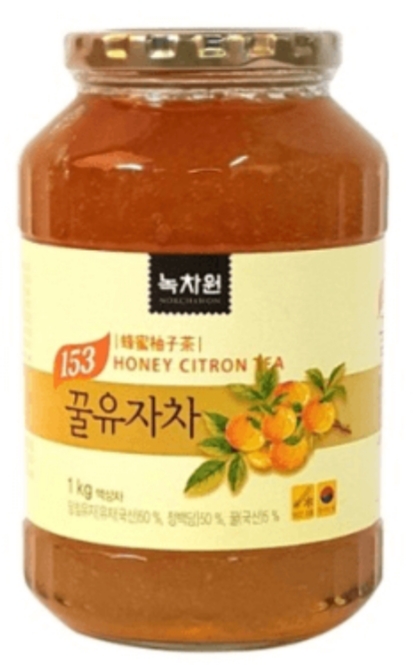
This gives you a sense of the consistency of their lemon tea. The quality of yujacha when it’s sold in a jar is evident here.
I bought some corn tea while I lived in Seoul. Some teas were sold in teabags and that is how I got my corn tea. Dried kernels of corn were crushed up in gauze-like bags and you’d set a bag in hot water that had been boiling and leave it in the pot to steep for a while. I had bought a little portable stove and a pot after I’d been living in Korea for 5 months and I made some corn tea before I left Korea. I liked a little sugar mixed in with my corn tea. It was rich-tasting and had a deep, sweet, corn taste when I sipped it. We had nothing like that in Canada. You can buy Korean tea that consists of dried corn kernels to boil and the kernels are huge and dark brown. Their fresh corn over there is not sweet or soft to bite into like it is in Canada. We have North American corn niblets in cans called ‘peaches and cream’ variety and use canned ‘creamed corn’ in dinners and we eat wonderful ‘bread and butter’ corn on the cob and it’s lovely but in Korea their corn on the cob is on the dry side with big kernels. They love it but it’s not very nice to eat. I tried it once and was surprised. In Canada and the US we have many recipes made using corn. We make soups and chowders and casseroles with it, etc. I saw corn tea and sometimes saw corn on what was supposed to be a Korean version of pizza while I was there. Besides eating roasted corn on the cob, drinking corn tea and putting a bit on fake pizza that’s all I saw corn used for.
This shows how Korean corn on the cob has huge kernels and is not enjoyable to eat, in my opinion, like it is in North America.Here is what big dried kernels for boiling in a pot of water to make tea look like. The tea is a pale, clear, gold colour.
There were vending machines everywhere in Seoul back then selling several kinds of tea. They were lemon, Job’s tears and another few kinds I can’t recall. The machines were everywhere, like the hot instant coffee machines were, and it cost 350 won or 500 won to get a little cup of your chosen hot tea. You could tell it was a powder though that was mixed into hot water. Just the same, I had gotten sick over there and had a few bad sinus infections and these little cups of hot tea helped me a lot.
This is one of the best pictures I took. It’s at Beomosa Temple north of Pusan. I have this framed on a wall in my living room. One of the monks is walking here in his grey suit and cosmos flowers are in the picture too.
While lost outside of Pusan…
While we were lost in what Koreans call ‘the countryside’ north of Busan, we had to walk back towards the city once we realised we would never see the fortress we wanted to go to. In the area, after we saw the goats, I left Robert on the road and walked up a path through some trees to see what was up there. It was so amazing! It was a small Buddhist temple. No one was there, or at least I never saw anyone. There was a nice vegetable garden on the grounds. It was so peaceful. Beside the wooded path that I followed, there was a pond full of lillypads with a granite pagoda in the middle.
When I stood at the temple and faced where I had just come from, this was my view. (Oct. 1999) A vegetable garden was beside here.
I remember looking at the huge tree in the picture above and thinking the trees in Asia really do look a bit different than in Canada. The huge trees above looked kind of squashed, but are still so big. I was so happy to be seeing trees like that and knew I couldn’t see them at home. I still remember standing there thinking about how the trees really do look like they do in the Chinese paintings and ink drawings.
The granite pagoda in the pond.The small temple in northern Pusan.
A very special thing was there. It was a small stone building with a thatched roof, or a grass roof. This is what houses were made like through the years and in the 1970’s the government under famous revolutionary President Park made everyone take these roofs away and put tiles on roofs instead. I do not agree with all buildings having to change and look modern constantly, as many times they are ugly when they are changed. They do this restructuring all the time. I wish Korea would leave many areas alone, for tourism purposes and aesthetic reasons too. The government should realise they are taking away the character of most areas and that the flavour of alleys and old buildings are lost forever from what they’re needlessly doing. Not everything has to be shiny and repainted. Unfortunately the government thinks that everything does have to be.
Special old structure with cosmos flowers and vines. (Oct. 1999)
Back to Busan….
Once I had gone back to the road and met up with Robert, I noticed a young guy waiting for the bus at a stop. I couldn’t believe a bus stop was out there, and wondered where the bus would be going if we got on? I tried to find out what the bus cost, or anything about it from the young Korean guy but he wasn’t helpful or friendly. I scaped up some change and we got on the bus that came and got off close to the downtown. I must have had to ask the bus driver ‘OlMaYo?’ to find out how much to pay when we got on and I must have had the right amount on hand. I was so relieved. It had been scary to me to be that lost. Funny you can do things in Korea quite easily without knowing their language. It is very safe since they are very well-behaved and they must obey all the social rules and the country’s laws all the time. I realise it was a great honour and privilege to be allowed to live there and to visit in 1999 later.
We were hungry for lunch and went in a ‘chicken house’. Korean ‘smoke chicken’ was very well-done and delicious. You ordered a plate of smoked chicken pieces and have a huge glass of draught with it. They serve a bunch of pickled radish with it, called ‘dan mu gi’, which means sweet radish. The Japanese version of this has yellow-coloured pickled radish but the Korean version is a much lighter colour and is crispy and fresher. We really would have loved something like rice or preferably french fries with our chicken but when we tried to ask, they looked at us like we were from outer space! Nowadays these places have mostly been replaced by ‘spicy chicken’ and fried chicken restaurants which are very good too, but those chicken houses were very unique at the time.
BeoMoSa in October 1999…
I am so glad I chose to go to the temple in the mountains North of Busan that was called Pomosa at the time and now called/spelled Beomosa. I had to follow instructions in my Lonely Planet guide and get us to take the subway to very near the temple. It would have been a dollar or a few dollars to get in. It was thrilling and I loved the statues and looking up at the mountains while we were there. Trees and wooded mountains were surrounding us instead of the city, which was different from the 2 temples I had been to in Seoul.
I found this was the most interesting part of the temple. I made Robert return here with me before we left because there were statues of human Asian men around this pagoda, and the mountains stood around us. When I look at videos of Beomosa now this section is gone as far as I know.
Sometimes people go in the woods beside the buildings of BeoMoSa now and it is a tourist attraction to be in these trees because of many little piles of stones scattered on the ground throughout one section. Old Buddhist tradition says to make a piles of stones to represent a pagoda in areas around temples. We went in these trees back then but it wasn’t thought of as a sensation at the time. There was shade from branches above and there were a few streams trickling down the mountainside. The woods in Korea are not wild like in North America, as people have been all through them for hundreds of years, I figure. They had tigers in these forests years ago and there is talk sometimes of reintroducing them to the forests in Korea. I always imagined soldiers being in the mountains during the Korean war when I was in any woods while in Korea. I never saw any underbrush ever.
One of the statues of a figure surrounding the large pagoda. There was a figure at each corner.
While we were near here an older Korean lady handed me a small treat. She had given one to a Korean girl too. They must do this at temples, I think. I can’t remember what it was, but it fit in my hand.
It’s very hard to recognise these places within the temple when I look at recent videos.Another statue guarding the pagoda.Cosmos flowers in the temple.
This will be the end of my description of our October 1999 vacation in Korea. When I look up information about Busan now I see that the population is not higher now than it was 20 years ago. I think it’s because the population of Seoul and surrounding area has increased so much, meaning many people move to the Seoul area now from other places in Korea. Many changes have occurred in Pusan, also, and there are many new buildings and bridges; some are elaborate. One day when we were looking for a meal near the Royal Hotel in the downtown core we found a Pizza Hut and ate there but it was small and cramped and crowded because there was a noticeable lack of restaurants in general, especially western ones. And there was a lack of space. In Pusan, there were and still are many mountains, and they keep mountains unpopulated, so this meant the buildings in the small valleys were more dense. We were very suited to have gone there and seen what it was like.
This courtyard looked so nice and authentic but we didn’t have enough time to explore it.
One of my favourite side dishes, KkarTuGe, pronounced ‘cartoogay’. I asked them what it was in the fall of 1997 while I was downstairs where we ate and they said it’s pickled radish with spices similar to kimchi and it’s always cut into cubes. The radish is very delicious when pickled and spiced.
Pusan in Oct 1999….
The city of Pusan was the second largest city in South Korea at the time of our vacation, with a population of around 3.6 million people. Pusan is found on the Southeastern coast of South Korea at its furthest Southeastern point. It is a huge port city as there are many, many, many containers of merchandise landing in or leaving Korea every day. I chose to go there because it was such a big city and because it was close to Kyeongju, although my husband thought it would be interesting to be in a city with such a large Asian port. Kyeongju, where the Sokkuram Grotto is found, is just north of Pusan but somewhat inland.
I am calling the city Pusan, as that’s what everybody called it back then. In recent years the way you are supposed to spell certain Korean names and words in English has changed. Places like Pusan are called Busan and spelled Busan if you’re searching for it anywhere now. My old neighborhood, Karak Market is spelled Garak Market. (Actually, it’s now called Garak Bon 1, having to do with the subway stop). If I am talking I still try to pronounce those ‘B’s like part ‘B’ and part ‘P’ and I try to pronounce my ‘K’s like part ‘K’ and part ‘G’ the way they said I should. It’s so difficult I can hardly do it now. What I mean is it doesn’t matter that they want us to spell the words differently because the pronounciation is the same as it always was. We spelled Kyeongju as Kyongju. Now it’s really Gyeongju instead. I find it’s all hard to get used to.
We took a bus from Kyeongju to Pusan one morning and arrived downtown. I found an ‘inn’ that had a large room upstairs in a building in the main busy streets. It was cheap, like $23, for the night. But during daytime and early evening hours there was a jackhammer in the area making a loud racket and I didn’t like that. It was more crowded and dusty here than in Seoul. Recently while searching online, I found out that Korea is much more densely populated than Japan is and I was surprised. For our second night in Pusan, we tried to go and stay at a hotel I thought would be nicer. It was called the Royal Hotel and it was beside the main park associated with Pusan Tower, in the heart of downtown.
Pusan Tower at dusk in Oct. 1999. We never visited up inside it but were near it for a few days.Robert is ahead of me here carrying our bags. We were on our way to the Royal Hotel in the main part of downtown Busan. This is a famous fashion area where there were expensive foreign clothing stores.
We had to wait outside on the pavement on the street in front of the hotel for a while before they let us check in, which is hard to do when you’re weary. However, it was great to be staying there because there were places to go outside at the end of the hallways of the hotel that were like shared balconies.
Here I am at one of the outdoor areas of the Royal Hotel. It was a good way to see panoramic views of the city. The trees on the right are part of the park with the tower – it’s a small mountain, YongDuSan.
While on this small balcony area outside at the hotel, I took pictures of the downtown and the harbour. People always marvel at my pictures of Pusan, saying the buildings and houses “are on top of eachother!” It looked like they squeezed what they could in an area that was too small but left the mountains uninhabited. A lot has changed now and there are new huge bridges to islands, an astoundingly large yachting complex, more museums, bigger shopping centres and taller elaborate condominiums to live in. I found it difficult because normal amenities were lacking like buying a cup of coffee or even getting a meal easily somewhere. I think there were less public restaurants there at the time and I looked for vending machines to buy a little cup of coffee like I found everywhere in Seoul and there weren’t any. At that time in Seoul, many places had vending machines outdoors where you’d put in 35 cents and get a small hot drink in a little cup. These drinks were a prepared instant coffee or lemon tea or job’s tears tea (‘nut’ tea) drink. These little hot drinks helped my sinuses a lot when I lived there, as I was sick some of the time with an infection. The pollution and lack of heat in my building didn’t help.
It was interesting to see these crowded buildings downtown near the harbour.This and the picture above are views from the Royal Hotel outside balcony. The Pacific Ocean is beyond the island in this picture. There is a bright orange bridge in the middle of this picture that goes to the island and you can see the water on the right.
We went to the park that had the tower in it that was beside the hotel and we walked up a long, winding tree-covered road for pedestrians-only to get there. The trees hung over this road so you couldn’t see anything but branches above you. Everything was dark and shaded while you went up the hill. I loved it because there were big birds that seemed to be similar to mockingbirds calling out and flying in these trees while we walked up the winding road to get to the park. And we had to wave to many people and say “Hello!” here. On the main street leading up to the road to the park, outside of the park, the mood of the people was lively and so happy. There were families and children everywhere. A group was cooking outside and asked us to try the treats they were making. They told us they were making ‘pumpkin treats’ that seemed to be like frothy, sweet-tasting blobs. It was nice and good of them to be so friendly. I had never heard of Koreans doing this or making such food.
Many parks have traditional structures holding large, iron bells, and this park was no exception.The park was called Yongdusan if I remember correctly, and there were a lot of pigeons the people seemed to really like.
Perhaps things are not the same today, but we found that the people in Pusan looked a little different on the whole than the people in Seoul. Many had darker skin. We thought it was remarkable that the distance from Seoul and warmer climate made a noticeable difference in people’s looks.
While we were in Busan I wanted to see the Fortress from years ago that was in the area. It was similar to the NamHanSanSeong wall. We got in a taxi and asked to go there but the taxi driver brought us to the wrong place. We were dropped off way outside of Busan on a rural road surrounded by mountains. We met an old couple that was hiking to the fortress. I realised we were let out where Koreans would make a long, long hike for many hours to get there.
This was a town in the valley where we were let off by that taxi-driver.
While we walked along the road when we were basically lost outside of Pusan, Robert asked me, “Is that a rooster crowing?” I said “No, it wouldn’t be a rooster out here….!” and as I watched the edge of the property beside us, a goat appeared. Another goat appeared beside him. They were looking at us curiously. I could not believe how lost we were and thought it must have been a rooster that Robert heard after all.
These are the goats!
While we were trying to sleep that one night at the Royal Hotel, we heard horrible loud music. There was a nightclub in the hotel somewhere underneath us and the booming racket went on until 3 in the morning. We had trouble getting any sleep or rest that night. When I looked down at the street at the many signs from our window I saw we were in a kind of entertainment area. I saw many signs for “no rae bang”, which is common to see in Korea. It’s karaoke. The ‘no rae’ is a ‘song’ and like I mentioned in a former blog post, ‘bang’ means ‘room’.
There were many karaoke places all over Korea and there still are. I went to one in Karak-dong with Sang Hyun in the fall of 1997 and it was nice to see what it’s like. We got a few beers and no one else was there that evening. You could choose songs from the list of songs available. Most were Korean pop songs but a few English songs were available at that time – these were the few old Elvis songs approved by their government, a few Anne Murray songs and a few John Denver songs, ha ha! I asked Sang Hyun to sing a popular Korean song by a kind of a Korean rap singer. I didn’t sing. What was different was that while all the songs played (just tacky music) you had to look at your own screen to read the lyrics, and the screens showed half-naked women the whole time! Women, Korean and caucasian, in bikinis making suggestive poses, changing to another picture and another one on and on. Over and over and over. I was kind of angry and it ruined things for me. I don’t think Sang Hyun understood my feelings and I did not mean to take out my anger on him but I kind of did. I wonder if they still do that nowadays there? For a while around the millenium karaoke became popular in the U.S. and Canada and many businesses sold karaoke machines so people could do karaoke at home, but it’s gone out of fashion. I see many NoRaeBang signs in videos of Korea now when I look. Karaoke was a big part of Korean culture back then and it still is.
(I’ll finish my Pusan story in my next blog. Thanks for reading!)
View of Old Downtown Seoul at night from Namsan Tower.
Kyeongju…..
Kyeongju is a special city full of cultural relics that is a must-see for tourists in Korea. I planned for us to take an inter-city bus to get there from Seoul and to spend 2 nights. Thank goodness I could find a lot of information in that Lonely Planet guide, as internet wasn’t available much then. One morning we took the bus to Kyeongju and travelled through most of Korea and could see forested mountains and colourful valleys the whole way. I loved that virtually nothing, usually not a dwelling or a building, was on the mountains but trees. Most valleys had cities or at least greenhouse farms in them. The highways there were very modern and efficient. We had to go several hundred kilometers to the south on the eastern side of the country to get there. On the way we loved seeing white egrets in the streams and marshes. Since Canada is further north than Korea and colder, there are no egrets ever to see.
Some people would not be bothered to look at egrets, but we both were thrilled to see so many in waterways along our route.
Travel within Korea was very affordable and downright cheap to me. Whether it was the subway, a bus, a plane or a taxi, prices were much lower than in Canada, in spite of the gas being much more expensive in Korea. So a bus ticket to Kyeongju was only around $16 per person and the distance was around 300km. The bus was nice and we only made a few stops.
Entry fees for everything there were low so all children could easily learn about their history and be proud of it. Income tax for the people was very low and there was no such thing as sales tax. There were so many great, better differences between Korea and Canada I saw and liked.
In Kyeongju, when we got out at the bus station, my guidebook said to go closeby and I would find several choices of affordable inns with rooms to stay in overnight. I followed the map in the book and found a place on a side-street. I asked the middle-aged woman running a restaurant with simple rooms upstairs if she had a room for us. It was only $23 for one night! Acquiring the room had to be done with a few Korean words like “bang issoyo???” (Do you have a room here?) and shoving Korean money at her. I had to say, “DooGae” and put two fingers up, meaning 2 nights. We had some sights to see while we were in Kyeongju so the room could be simple, as we weren’t going to spend much time in it. There was no elevator but the room was quiet and had a bathroom and we never did see anyone around for the whole time we were there. It was very different from Seoul. They were trying to keep Kyeongju traditional-looking and not advanced with no huge shiny office buildings like in Seoul. I remember missing the amenities you could get in Seoul like a cup of coffee here or there, a western chain restaurant or even seeing an English word on a sign somewhere.
A typical photograph of Kyeongju has these royal burial mounds in it. The mounds are huge because of the importance of royalty buried there. Regular people have smaller burial mounds. Famous treasures have been found in the area, like old crowns and old Buddhist artifacts. You can see the many mountains around the city.
It’s awful to not exactly remember our schedule from 20 years ago now, but I certainly remember seeing the sights I had wanted to see and some other surprise things also. I know I got us to take a bus or taxi to the most-visited Buddhist temple by tourists in Korea, Pulguksa. However, it was a special day at the temple when we went, and the famous front of it, where there were several distinctive stone-bridge staircases, was covered up by a huge banner. It seemed to be an important event with a high-level monk speaking to the crowd the whole time. We walked through the grounds behind him just the same.
I do remember it was too hot for me, even though it was October, and soon after our arrival in Kyeongju I had to get a taxi to take us to a place where I could buy a hat as a sheild from the strong sun. The sale stand was just an outdoor area with items on the pavement like unattractive hats you could buy. I thought my hat was really a man’s hat but it’s all I could find and I was desperate. It was so ugly I never kept it, but I was thankful to have it at the time.
This is not my picture but it’s what the stone-bridge stairs at PulGukSa look like. It’s what we didn’t get to see.This is a good picture from a book about Pulguksa of what the pond and stone bridge look like in spring.
When you enter Pulguksa, the first thing you come upon is the beautiful pond and stone bridge above. My picture was not as good as it should be because of the bright sun. I had seen and heard so much about this temple that I was thrilled to be there. Robert wasn’t very thrilled, and said all Korean traditional-style buildings were the same. I wholeheartedly disagreed.
Here’s my picture of the pond and bridge at PulGukSa. ‘Sa’ means ‘temple’.I was looking up at one of the main buildings. It was very crowded that day. (Oct. 1999)This is from a book about visiting PulGukSa. It shows some of the gold-coloured statues in a main hall there.
All Korean temples have statues of Buddha in them. They’re usually gold-coloured. At Korean temples, the monks’ dress was different from other countries’ dress, and the design of the statues and buildings were unique to Korea too. I never did see the inside of any main temple buildings, as people were trying to seriously meditate and worship at all of them. At PulGukSa, even the stone walls outside were distinctive from other sites and there were special artifacts to see also.
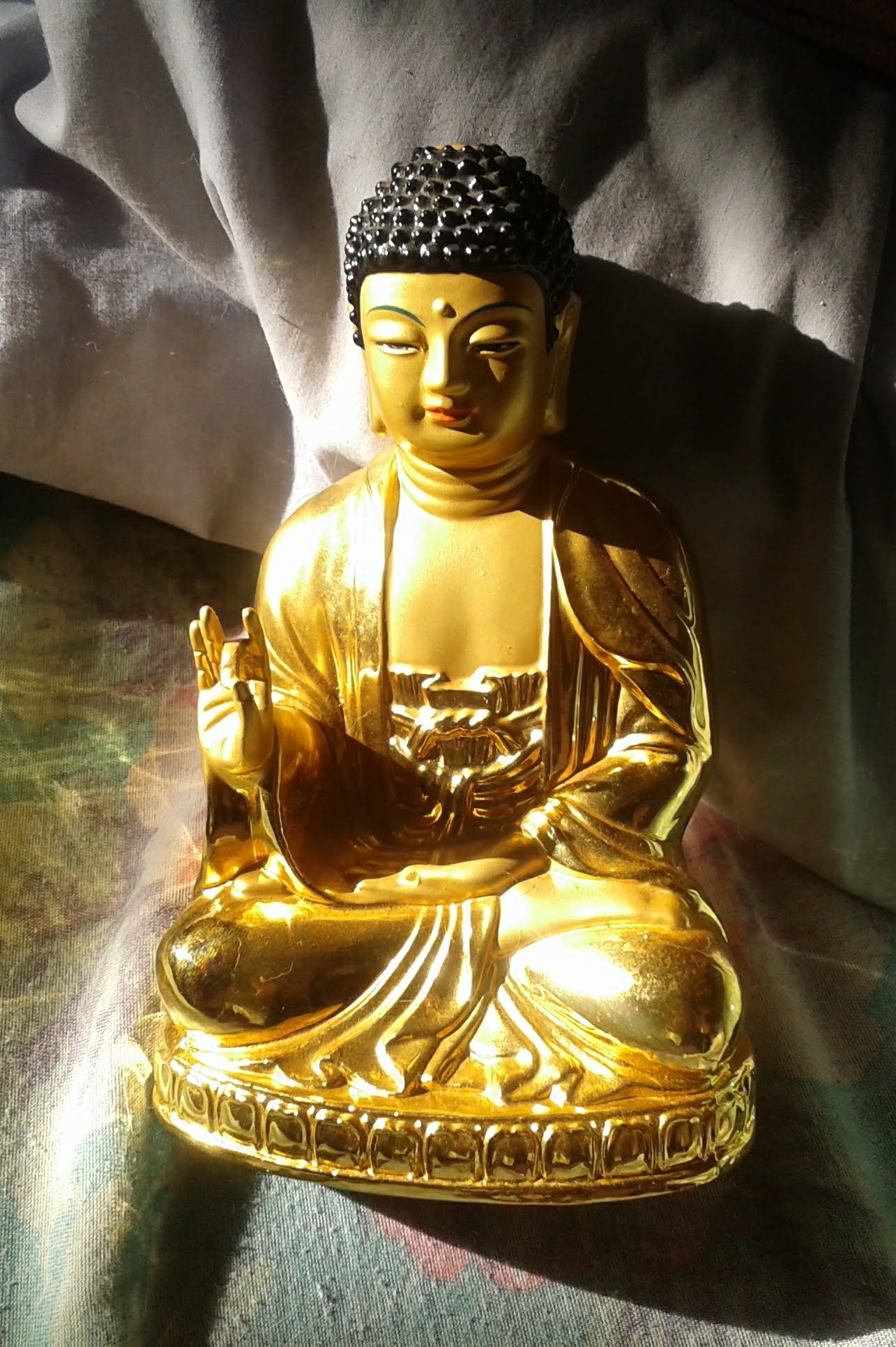
This is my souvenir from Korea I bought at ChogyeSa Temple in Seoul in 1998. It’s about 8 inches high and is in the style of what’s inside the temple buildings on alters. He’s heavy and cost around $20 twenty years ago.These stone walls remind me of The Flintstones.There were 2 stone pagodas in the main courtyard. This one was hundreds of years old and almost 4 stories high.
When we were finished seeing the temple, we came out near a large tourist village with traditional buildings peppered on the hill below PulGukSa where you could stay overnight or get a special meal. I had read in my guidebook that women came to get customers to go to their dwellings to eat a meal or have a homestay overnight. This is what happened. A Korean woman hailed us and wanted us to come to her house to have a Korean lunch. We did need to eat after viewing such a large place and it was lunchtime, so we followed her to one of the tile-roofed buildings. I ordered soy-bean paste stew for us. She made it in front of us and served us each a huge stone bowl that was hot and the stew sizzled. It was perfect. We could look at the scenery and mountains while we ate. I kept looking up at one extremely beautiful mountain and the woman said, “Sokkuram…” It was where we were going next – a Buddhist statue in a grotto in that very mountain!
For me, seeing Sokkuram Grotto was the main attraction to visit on my vacation. Whenever I saw a picture of the statue I thought it would be so exciting to see.
There are many mountains like this to see throughout Korea.
I only realised years later that we had made a pilgrimmage to the grotto when we went to see the special buddha that day. It’s considered to be the most beautiful statue of Buddha in all of Asia. The grotto, with the granite Buddha and carved Buddhist figures surrounding him in Sokkuram mountain, was rediscovered after having been forgotten for years when a postman had to find shelter from a storm in the 1950’s by going in the cave. It’s astounding that people could create such carvings in a cave hundreds of years ago and its mysterious as to how they were completely forgotten for years. Many Korean people were making the pilgrimmage that day as well as many students in their school uniforms. We had to wave numerous times and say hello, as they kept hollering, “Hello!!!” happily when they saw us. It’s a unique experience all around.
We took a special bus to the top of Sokkuram Mountain first of all. The bus went extremely fast up a winding road at the edge of cliffs all the way up. At the top, there was a nice view of all of the mountains surrounding this area. There was a huge traditional building also. Everyone had to take a long hike through a wooded path from there to get to the grotto. I knew from reading my Lonely Planet book that there were no pictures allowed and that the buddha was behind glass. The whole experience was wonderful in spite of those things. It was probably a dollar for the bus and I don’t think there was a fee to see the buddha.
This is the huge traditional building where the bus lets you out. I thought perhaps there was one of their large metal bells inside of it. Below the traditional structure was this other carving and there was a water fountain for drinking attached to it. A chipmunk was scurrying around there too.This is me below the building at Sokkuram and there’s a turtle statue beside me. (Oct 1999)Here is my own picture of the view from the area where you had to start your hike to the grotto. The haze or ‘pollution’ always made everything look faded more in pictures. I loved such a view, however, and the view was 360 degrees.
At the end of the more than one-hour trek through the forest, was a little building where you lined up and waited to pass through the inside or front of the grotto where the beautiful pinkish-gold granite Buddha sat. You had seconds to admire the statue behind the glass and many people would line up to do it over again. We only did it once. A Korean man who was near us in the line-up exclaimed to us after we had gone through, “…That’s it!!… It’s all finished!!!… All that way and it’s done in a minute!!!…That is all…!!!..” I think he and his wife went in the line-up again. We just smiled and chuckled. One remarkable thing was that the granite walls surrounding the Buddha were all carved with other Buddhist figures also. Sokkuram Grotto is studied as geometrically and mathematically designed so it’s interesting on many levels.
I looked back after passing through to see the grotto and took this picture. You can see the students in school uniforms and if you look closely you can see people lined up to go through the larger building to see the Buddha in its grotto. We didn’t go to the other little building at the top of everything on the left.Finally, I inserted a picture of what you see when you pass by to look inside the grotto. It’s from a tourist book. The statue is 12 feet tall!
The fact that we saw Kyeongju, and had the strange fast, winding bus ride and saw others making the pilgrimmage certainly made the trip worthwhile. The view of the mountains and the chipmunk and egrets made it worthwhile too.
On our next day in Kyeongju we went to see some historical artifacts. We went through one of the parks that had “tumulis”, or mounds where royalty or their precious belongings were buried near them hundreds of years ago. While we were there, I fed a small box of crackers to the koi in a pond. It was thrilling. The koi were huge and one was peach-coloured, one was orange, one was yellow, one was gold and on and on. They loved the crackers! We also sat outside of the park, near it, and spoke to an old Korean man who was sitting there. Funny, you can communicate a lot with just a few words and gestures. He wanted to know what country we were from and we also said we were married, I remember. I knew how to say I was an English teacher (yong-o kyosa) and now I say “IMF Time…” instead of learning how to say 1997. I can say where I lived and and I know “sorry”, “wait”, and “excuse me”. I like to say “Han guk”, meaning South Korea and “saram” is people. So when I speak to a Korean person I can mention Korean people or Canadian people.
This is in the Tumuli Park we toured. Those 2 hills are burial mounds and the trees are flowering fruit trees. Men were trying to mow the sprawling lawn and security guards were blowing whistles at people who stepped off the path and trod on the grass.One of my pictures of the koi that day. Many were black. Koi are bigger than you’d think: many are close to a foot long. Stock photo of koi that are similar to the koi I saw in ponds in Korea.This was a special observatory found in Kyeongju that was constructed for the queen 600 years ago.
We came across the old observatory and I was happy to imagine the royalty studying the stars many years ago by looking out of this stone structure.
On our second night at the inn, we went up to the rooftop patio and had a relaxing, enjoyable time looking at the area in the dark. I found a bottle of delicious milky-looking rice wine at a store nearby and had some of that while we were up there. This is a particular type of rice wine called makkeoli that is from old times. It’s sweet and pleasant, not strong-tasting and clear like their most commonly bought rice wine that to me is like vodka(soju). We looked at all the mountains surrounding Kyeongju in the dark and I tried to study the few mysterious lights on them which showed where perhaps houses or temples must have been – I wondered what was where those lights were. The time up on that roof was unexpected and unplanned but added to the experience of the trip.
I bought a vase that mimics a famous style of pottery from Korea. This type of pottery often had these cranes on its vases. I like that even though it’s a cheap replica it depicts the cracked glaze as well as the birds. These vases are usually light green. It’s about 12 inches high and cost around $20 in 1999.
This is Eastern Seoul. The Olympic Bridge from 1988, with the middle sticking up distinctively, is crossing the Han River. I lived about 4 km from here (if you go to the bottom and to the right).
Seodaemun…..
Seodaemun is the area just to the west of Kyeongbokkung Palace. It was important for me to go because the West Gate of Seoul was here and that long, beautiful mountain with all the granite on it, InWangSan, was here as well. The day we decided to go to the area, we found ourselves near the west gate, and a few young Korean people came out of nowhere to say we should really come and see a museum that was right there. They worked at the museum, apparently. I got the impression they had been told it was better to recruit foreign tourists to see this museum. No wonder. This was the most interesting museum I’ve ever heard of. We followed those Korean people to the entrance as we did have time to go and it only cost around a dollar each to get in!
Seodaemun Prison Museum…
It was the Seodaemun Japanese Prison Hall. This was a testimony to the last time that Japan had taken over Korea. And it was like we had the whole complex to ourselves, as we seemed to be a few of the only people there. A young Korean staff-member showed us parts of the place and gave us a lot of explanations.
These are the actual old buildings the Japanese built in the early twentieth century to house Korean dissidents during the last Japanese take-over. We went through these.
For around 30 years from something like 1915 to 1945, Japan had ruled Korea and they kept Koreans who were freedom-fighters or who refused to submit in this prison. One thing I was surprised about was that one of the main prisoners was a woman. There was a mannequin in a tiny dark cell that was supposed to be her and we could look into this cell to see how she was forced to live. The most amazing thing to us was a display room with a mannequin who was supposed to be a Japanese guard watching a prisoner being tortured. The guard was moving in his chair, rocking with enjoyment, and holding a lit cigarette. He was relaxing and had his legs and feet up on the table in front of him. It was very lifelike and also was another way that showed how the Korean people created their elaborate museums.
On the right where the person is walking there’s a white brick facade that remains of the Japanese-built entrance to the prison. We entered there.
When we came out of the exit, the huge, looming InWangSan mountain greeted us, and I was so thrilled to be so close to it that I took a picture of it showing the granite design it had that looked like an ink painting.
Here is InWangSan. It was beyond remarkable in real-life.
Tongnimmun….
I found the West Gate, also called Tongnimmun, near the Japanese Museum. It wasn’t like the other tiled-roofed gates, and was the first western-style structure built in Korea, modelled after the Arc de Triumphe in Paris. There is a picture in existence of the original gate that was destroyed before this one was built and the gate is not like this one. It looks more traditional. The old west gate was used by Chinese royalty when they came to visit Korea from the west and its 2 pillars that were left standing are in this picure behind the Tongnimmun Gate towards the overpass. This current west gate, the one I took the picture of below, called Tongnimmun, is called Independence Gate, signifying independence from China as well as Japan. People weren’t allowed to walk through Tongnimmun when I was there and you can see the iron fence around it in my photo. Nowadays people can walk under and through it and the area has been made into an Independence Park.
Dongnimmun, or the West gate of Seoul. (I called it Dongnimmun because their ‘d’s are like ‘t’s in their language) It is made of cement and many pieces of granite.
Environmentally Conscious…
Even in 1997, Korea did things sensibly like save the environment in a more effective way than people do in North America. When I was living there, someone in Korea could order a delivery from a restaurant and it would come with real dishes that looked like melamine. No matter where the customer lived, after the food was eaten, the customer would put the tray with the now-dirty dishes out in the hallway on the floor outside of the door for the driver to pick up later. The dishes would go back to the restaurant and be cleaned and reused. The government there is not like people and companies in Canada where disposable dishes, usually not recyclable, are constantly used and thrown away. In Canada, one problem is that most people are not honourable enough to not steal the real dishes. Also, companies in Canada would be unwilling to pay delivery drivers to pick up the used dishes and return with them to the restaurant. Too bad they can’t do that environmentally responsible use of dishes in the west though.
Chinese Exhibit…
JiYoung, my roomate from Karak-dong, took Robert and I to a museum in the southeast of Seoul in January of 1998 when he had visited me. It was an exhibit about China and it was huge. I remember everything was in Korean or there was no proper information to read at all, so when there was a Xian warrior on a horse in a glassed-in case, I wanted to know if it was a real clay warrior or a replica, but I couldn’t find out. I did learn that China has around 20 separate cultures and has other languages than Cantonese and Mandarian and there are many different dialects of each language as well. We don’t learn in Canada about their diverse groups within their country. At one point we saw a section which seemed to show Europeans first arriving there and the information must have said some awful things about them because after that part we were getting dirty looks from people in the crowd as we passed them on the stairs.
Many, many times I had to take the subway and the system was similar to this. This is an Express Train though, which didn’t really exist when I was there, as it says KoRail on the side and the station is outside.
My favourite room was the one where an antique, giant, silk-embroidered banner went the whole way around the edges of a room. It was in a number of long wooden cases under glass. I looked at the intricate embroidery and it was an old scene showing peasants going about their business. The scene showed royalty too. There were animals they raised to eat and ‘ox carts’ in the streets. People having a meal in their traditional homes were depicted. One part seemed to be the emporor in palacial buildings with his servants incorporated into the scene, along with many rich Chinese ladies at a large party in another continuing section. There were trees and flowers and many details everywhere. I love Chinese art, especially very old art, so I looked at this embroidery for a long time. It was lifelike yet had that quaint look that Chinese artists used to create in their work. The fact that it was so old and all embroidered made it even more beautiful.
Outside of the large museum we saw an older Korean man cooking chestnuts at a barbecue-type stand to sell to people. Chestnuts were commonly eaten and most times they were raw. I had never eaten chestnuts in Canada, although we have chestnut trees, and I had some raw ones while I lived in Seoul. They’re very good and must be healthy too. Raw chestnuts are peeled and cut in neat geometrical designs and arranged in organised piles on ceremonial plates to have at fancy food tables during their Chuseok or Solnal meals.
Namhansanseong….
I remember being told about the NamHanSanSeong fortress wall south of Karak-dong by a few Korean students in the fall of 1997. When I planned my trip I wanted to go there. I did it the hard way, as my Lonely Planet book only explained to go by subway to a certain stop in Seongnam and then hike up the mountain there to get in the park. This was lovely but very difficult to do. It was quite steep and many Koreans were climbing as well. There was a temple on the way up but I didn’t explore as I wanted to make it to the top. After an hour and a half of climbing we came to the huge South Gate in the picture below. We went under and through it and then we walked along stone wall, which was like a mini-Great-Wall-of-China running along the top of the mountain range there.
South Gate at Namhansanseong NamHanSanSeong is one of UNESCO’s protected cultural world sites.
When you walked along the wide path, you walked along the fortress, which was 500 years old. The wall was built because one of the kings had to be protected from Chinese invaders at the time, I believe, but Korea had Japanese and Mongolian invasions and threats through the years as well. You can view Seoul from the southeast at one point on this trail but we couldn’t see it well when we came upon this spot. A great thing was that a Korean man started talking to us on the walk, and stayed with us talking and walking. He was a nuclear physicist! He said he liked Celine Dion when we said we were Canadian.
The nice Korean man took this picture of us on the trail. The wall is around 15 feet long/tall on the other side of the path, which gave protection to whoever was inside the walls 500 years ago.This is a shrine to one of the kings along the trail in the western part of the park.I find this is my most beautiful picture of all and it’s the shrine in the western part of NamHanSanSeong. There was a group of soldiers doing exercises there while I took the picture. You can see their shadows on the right on the steps. I didn’t dare get them in the picture, as you had to always ask permission to take photos, even at sporting events.Another picture at the shrine. There are a few shrines there and at another one the Koreans do an annual reenactment of the history of it to honour a dead king. Like at Jogmyo Shrine downtown, they dress as king’s attendants in satiny robes with large black hats and beat a ceremonial drum in a procession.
We wanted to leave the park after hiking there for a while, and the Korean man didn’t know where to go or how to get out either. I remember him saying that to us. He suggested going down another trail through the forest that headed downhill further into the park. It worked! After a time we came upon a “tourist village” where people, especially foreigners, at the park could eat a special meal or get a bus home. I wish I had known about the buses.
Here is the man who helped us and talked to us that day walking with Robert in the tourist village after we emerged from the long forest trail.This was one of the restaurants in the village that tried to entice foreigners with its tiled roof and real kimchi pots under the burgundy banner. The banner says special tofu from the area is on the menu, as well as Korean pancakes.Another picture at the tourist village.
Finally, and I don’t know how he knew, but we followed the Korean man to a bus stop and he got on the bus too and told us where to get out to get the subway to get to where we were going. The people there are extremely helpful and everso curious about foreigners.